Enhancing Every Garment

Introduction
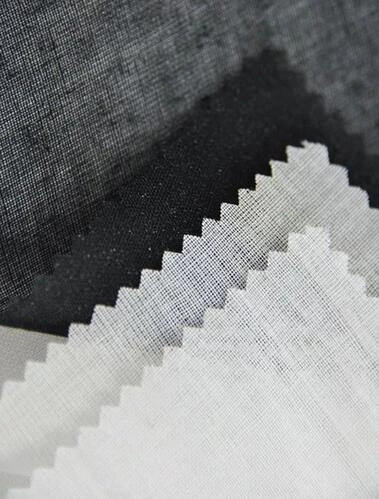
In garment manufacturing and haute couture, woven interlining plays a vital role, despite often being hidden beneath the fabric. Essentially, woven interlining is a special textile accessory made of warp and weft yarns, identical in structure to the regular woven fabrics we see every day. This matching woven structure allows it to integrate better with the main fabric, avoiding harsh lines or unnatural draping.
The core function of woven interlining is to provide extra support, shaping ability, and stability to the fabric. It can increase a garment’s thickness and stiffness, preventing it from losing its shape during wear and washing. Imagine a suit lapel without interlining support—it might lose its original form after a few wears. Similarly, a shirt cuff without the reinforcement of interlining would struggle to remain flat and sharp.
Compared to non-woven interlining, woven interlining, due to its unique woven structure, has greater resilience and tear resistance while maintaining good breathability. This results in a better feel and more comfortable wear for the final garment. Therefore, it is widely used in areas that require precise shaping and structure, serving as a secret weapon for tailors and designers to achieve perfect garment silhouettes.
Woven interlining is not a single product; it is categorized into various types based on its purpose and characteristics, with each type playing a unique role in different parts of a garment.
This is the most common type of woven interlining. It features a uniform layer of hot-melt adhesive on one side. When heat and pressure are applied with an iron, this adhesive melts and permeates the fibers of the main fabric, creating a secure bond.
This type of woven interlining is specifically designed for jackets, coats, and overcoats. It is generally thicker and stiffer than the interlining used for shirts, providing a stronger “skeleton” for the garment to create a full, well-structured silhouette.
This is a type of woven interlining dedicated to shirt collars. Its main purpose is to maintain the collar’s perfect shape, ensuring it looks neat and sharp for both daily wear and business occasions. This type of interlining is often available in various stiffnesses to suit different shirt styles.
| Feature/Type | Woven Fusible Interfacing | Jacket Interlining Material | Shirt Collar Stiffener |
|---|---|---|---|
| Main Function | Quick bonding, shaping, wrinkle prevention | Enhancing silhouette, providing skeletal support, adding thickness | Keeping collars crisp and shapely |
| Primary Application | Plackets, cuffs, waistbands, pockets | Jacket front, shoulders, lapels, armholes | Shirt collars |
| Stiffness/Thickness | Relatively moderate, chosen based on fabric weight | Thicker and stiffer, provides strong support | Varies from soft to hard, multiple options available |
| Bonding Method | Heat-press fusion | Heat-press fusion or hand-sewn | Heat-press fusion |
| Advantages | Easy to use, strong bond, high efficiency | Excellent shaping effect, more three-dimensional garments | Long-lasting collar shape, resistant to deformation |
The value of woven interlining extends far beyond the standardized shaping in mass production. In the fields of haute couture and hand sewing, it is considered the foundation of artistic creation, playing a more sophisticated and critical role. Here, it is no longer a simple accessory, but a “canvas” that embodies the craftsmanship of designers and tailors.
In traditional haute couture menswear, a special case of woven interlining—tailoring canvas fabric—is an indispensable soul. It is typically made of wool, horsehair, or a cotton-linen blend, possessing excellent toughness and breathability. Unlike fusible interlining, this type is sewn by hand to the fabric, forming an independent “skeleton” that supports the entire suit’s shape.
Categorizing woven interlining as “sewing support fabrics” is the best summary of its versatility. Whether used as a lining for a handbag to keep it upright or for local reinforcement in a dress to prevent tearing, it is a reliable assistant. In the projects of hobbyists, it can make simple creations look more professional and structured.
From industrial production to haute couture and personal creative projects, woven interlining demonstrates its irreplaceable value. It is not merely an accessory, but a bridge connecting design concepts to the final product.
Woven interlining may not be the star of a garment, but it is undoubtedly the “invisible hero” that determines a piece of clothing’s success. It hides beneath the fabric, silently supporting, shaping, and protecting every detail. From the efficient fusible interlining on the production line to the “tailoring canvas” hand-stitched by artisans in haute couture, the existence of woven interlining transforms soft fabric into a structured, living piece of art.
Understanding and utilizing the different types of woven interlining is key for every apparel professional and enthusiast to improve the quality of their work. It can keep your shirt collar crisp, your jacket’s silhouette defined, and your handmade bag three-dimensional. The next time you admire a garment’s excellent cut and perfect shape, consider that it might be thanks to the contribution of woven interlining. It is more than an accessory; it is the bridge between a design concept and the final wearing experience.
1. Q: What is the difference between woven interlining and non-woven interlining?
A: Woven interlining is a type of interlining made from woven warp and weft yarns, which is structurally the same as the main fabric. It therefore has better softness, drape, and breathability, and is often used in high-quality garments to maintain their natural form. Non-woven interlining, on the other hand, is made from fibers bonded chemically or mechanically. It is less expensive but relatively stiffer and more brittle, and is typically used for quick, low-cost shaping. Jiaxing Rainbow (UBL) Interlining Co., Ltd focuses on producing high-quality woven interlining to meet customers’ demands for garment quality and shape.
2. Q: How do I choose the right woven interlining for my project?
A: Choosing the right woven interlining primarily depends on your fabric type, project purpose, and desired stiffness. Generally, you should choose an interlining that matches the weight of your fabric; for example, lightweight fabric requires lightweight interlining, while heavy fabric needs a heavier one. Also, select the stiffness based on the part of the garment you need to shape (e.g., collar, cuff, or the entire body). Jiaxing Rainbow (UBL) Interlining Co., Ltd has a professional R&D team that can provide customized solutions and products based on specific customer needs, ensuring you get the most suitable interlining.
3. Q: What are the advantages of Jiaxing Rainbow (UBL) Interlining Co., Ltd in woven interlining production?
A: Since its establishment in 1995, Jiaxing Rainbow (UBL) Interlining Co., Ltd has been one of the leading interlining producers in China. We have rich experience in the professional design, development, and production of fusible interlining and always focus on the research of high technology in interlining. With the development of the industry, the progress of technology, and the changes in customer demands, UBL seized the opportunity to upgrade its production equipment in 2000. We became one of the initial double-dot coating manufacturers in China. At present, we have a monthly production capacity of 6 million meters of all kinds of double-dot interlining. “Stand high and aim to scale new heights.” With sharp foresight, UBL has made enormous developments. Our concepts are “Practical, professional and forge ahead with determination.” UBL will provide the best products and services to our customers based on 19 years of experience and technology. UBL insists on technology innovation to create the most valuable enterprise and promote the development of society.